Kastelet or Citadel is an old fortress, located in Copenhagen, Denmark…
It is a tourist attraction near other important places such as the Little Mermaid and the Gefion Fountain, which I wrote about here. The road from Little Mermaid to the fortress is straight and nicely paved.
You can buy various souvenirs there.

If you have a boat, you can park it in a nearby port.

You will also pass by the monument dedicated to the Danish sailors, who lost their lives in the First World War.

About the fortress
The fortress was built in the 17th century, but even today it is one of the best-preserved fortresses in Europe. In fact, it is so well maintained that it is still used today to house active soldiers and officers in the Danish army.

King Christian IV initiated the construction of this defensive fortress in the 17th century.

If you look at the fortress from the air, you will see that it is built in the shape of a star with five bastions and an excellent trench system. It was built in accordance with the doctrine of the time, which is based on Renaissance military architecture.

The fortress is entered via wooden bridges.

Of course, the path leading through the fortress is made with my “favourite” cobblestone.
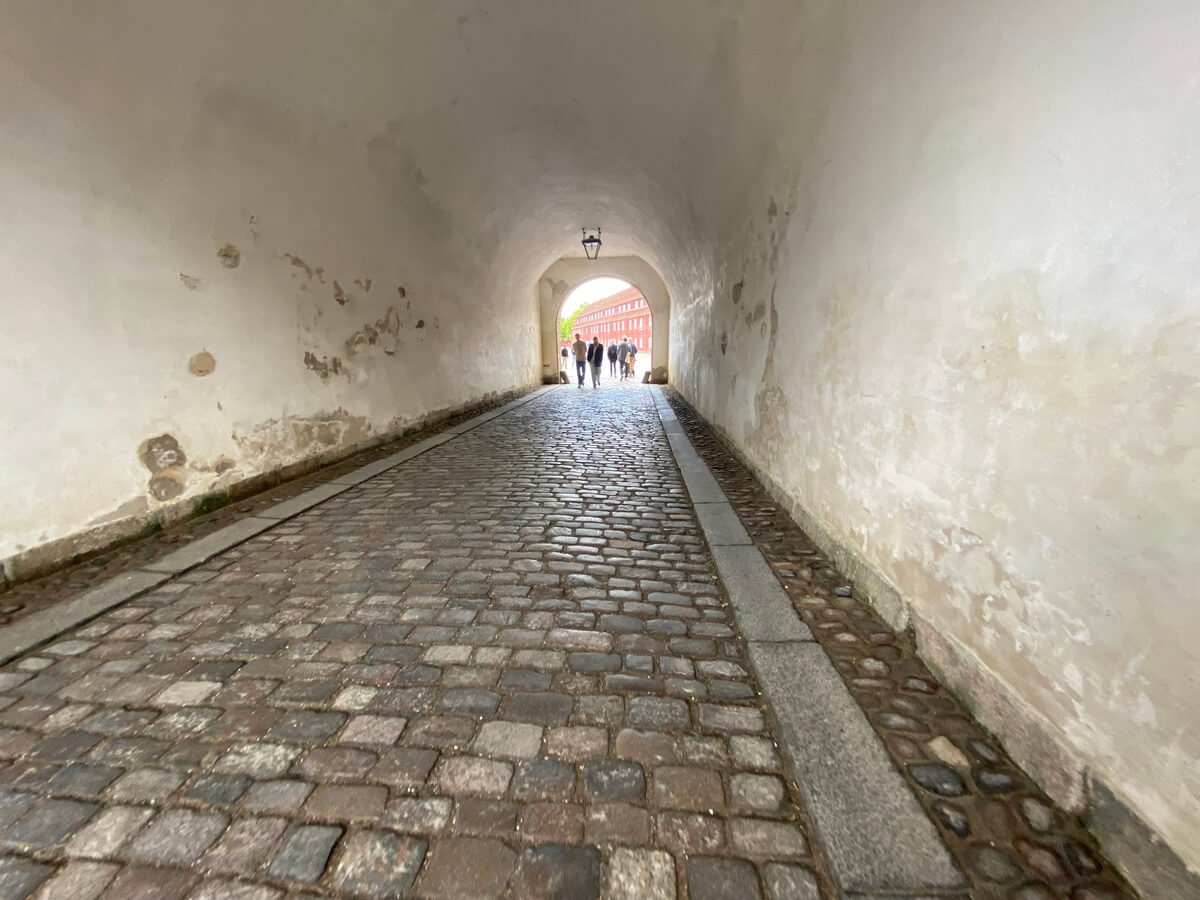
This time the cobblestones were stronger, so I just peeked into the fortress and walked around it. I prefer to save my kidneys and wheels.
What else can you find in fortress?
Behind the gates is a long row of red shacks.

In the past, entire families of soldiers were housed here, and today these buildings belong to the officers of the Danish army and the Danish Ministry of Defense.

No noise or painting on the walls is allowed. Order is known here.


Here is also the Commander’s house, where the commander was housed.

Today, this building serves as an information center, which monitors the activities of the Danish army since 1948. We, from the countries of the former Yugoslavia, are well aware of the participation of the Danish army.

The Danish are very proud of these activities, and you can judge for yourself how it was for us with them.


Here is also a monument erected in honour of Danish contributions to peace operations around the world since 1948. It is dedicated to the soldiers who were or will be active in these endeavours. It consists of a granite wall where there is an inscription: “A Time – A Place – A Man.” The wall was built in 2011.

Within the fortress there is also a small baroque church built in the 17th century. The church has been renovated several times and is still in use today.

Every fortress has a prison, and Johan Friedrich Struensee, known for his affair with Queen Caroline Matilda, was imprisoned here.
The fortress must be independent in terms of food, so there were also several windmills for grinding grain, of which only one survived. It worked until 1903.

Castellet also represents the green lungs of the city. It is surrounded by a beautiful and carefully maintained park.

Here you can rest, jog, walk and reboot. You can get away from the hustle and bustle of the city, and the coast is close by.
While I was walking around the fortress on a longer path, we were also caught in the rain. Without the possibility to hide somewhere, we enjoyed another Danish specialty, that is. changing weather.

Fortunately, the dizziness from flying and getting up early helped us to accept the existing situation with philosophical peace. This was the first day of the visit so we pushed on enthusiastically, wet and distracted by the historic, unforgiving Danish cobblestones.

On the other side of the fortress, you will find a monument to the soldiers who lost their lives in World War II.

Conclusion
Castellet was certainly in my plan. I didn’t stumble upon it by accident, I wasn’t filling up extra time. That’s why I feel guilty that I didn’t manage to visit it properly.
But I’m used to the world not being tailored to me and I adapt to the circumstances and roll into new adventures.

Have you visited Castellet?
Did I miss something?
Traveled and enjoyed,
Marko Veličković