Prague is one of the most visited European metropolises because it is full of places to discover. This is best done by walking, which is also free…

The best route is part of the former royal route. Kings and queens passed through it during their coronations, as well as numerous couriers, who brought important shipments for the king. It connects the Old Court with the Prague Castle.
The route is about 4 km long and is certainly the most important walk in Prague. The name Royal Route has been in use since 1955.
People in wheelchairs must have an assistant for this route, as it crosses over to the other shore. The route leads to the Prague Castle and from there the uphill starts. The entire road is under cobblestones, there are smaller and larger blocks and the ride can be quite bumpy.
If you don’t stop anywhere, this walk is no longer than 1.5 hours. Along the route you will find the most famous landmarks of the city.

History
The first coronation of the king in Prague was on June 15, 1086. in Visehrad. Later, the seat of the kings was transferred to the Old Palace in 1383. Many years later, when Prague began to flourish under the reign of Charles IV, the construction of a new palace in Prague Castle began. Charles IV hoped to be crowned in the Cathedral of St. Vitus, which had been started at that time, but he did not see it, he died before its completion.

Instead of him, the first to be crowned was King Sigismund of Luxembourg in 1438.
Since then, until the dissolution of the Bohemian Kingdom, a total of 26 kings and 28 queens have taken this route during their coronation. The last coronation took place in 1836.
Coronation Day
All coronations look alike. It all starts early in the morning when the bells from St. Vitus Cathedral mark the start of the procession. The king and queen are already dressed in their coronation robes. All important dignitaries are already here.
All the houses, past which the royal procession will pass, are richly decorated, and the balconies are full of people who are dressed in their best clothes.

Everyone shouts and throws flowers at the royal procession.

The people have a lot of fun because the royal wedding is also an opportunity to have the best time. In addition to the bells, a lot of cannons from the fortress also make a lot of noise.
The King is expected to toss coins into the crowd. In order for good fortune to accompany him during his reign, the king is obliged to release several prisoners as an act of mercy and goodwill.
Sometimes the subjects’ enthusiasm in paying tribute to the king is excessive and leads to unexpected results. For example, legend says that during the coronation of the future King Ferdinand in 1527, four young men jumped into the Vltava River to show their loyalty to the ruler. In the general euphoria, one of them forgot that he did not know how to swim and drowned.
In another case during the procession, a herd of camels was brought into the city, which caused more attention than the procession itself.
Municipal house
Start your royal tour at the Municipal House.

Namely, in 1383, King Wenceslaus IV built the Old Palace on this very spot. The court had its own residential quarters for the king and the staff who worked there, then a large spa and grandiose gardens. There was also a small zoo where the king kept rare specimens of animals such as two white lions.
Unfortunately, in 1689, a fire broke out in Prague. It spread to the Court, which had no escape. It was then decided to move the court to the other side of the city during the construction of the Prague complex. On the site of the old manor today there is an ordinary municipal building.

This building, which represents a real pearl of Art Nouveau style, began to be built in 1905. It was supposed to serve as a gathering place for the Czech elite of that time. Various social events, concerts, exhibitions were held there. The most famous Czech designers were hired to decorate the interior of this building.
Today, among other things, there are various places for dining here. If you are in the mood for fine dining, there is an elegant French restaurant here.

This restaurant is richly decorated with original furniture from 1920, and even the crockery is integrated into the interior. Luxurious art nouveau chandeliers add to the festive atmosphere.

I didn’t check, but I don’t think you can enter here in shorts and slippers. If you are not in favor of this option, a real Czech pub and local specialties are at your disposal.

This is the best start to the walk, so here you go.
Powder tower
We continue our walk and come across an intersection dominated by a mighty tower in the Gothic style.

It was built in 1457 and had a defensive role. This is the only surviving tower of the 13 that once protected the city.

The name it bears today comes from the 17th century when it served as a storehouse for gunpowder. Today you can climb into it and see the city from a bird’s eye view.
We continue our walk through the picturesque streets of Prague.


A long time ago, merchants used to pass through here, bringing their goods to the city.
Since they also needed a place to sleep, the more affluent began to settle permanently in the city. In order to further indicate their activity, each of the houses had special signs and boards, which without a doubt showed what the owner was doing.
This is because the majority of the population at that time was not literate.
Old Town Square
Soon, if you don’t linger looking at all those details on the houses, you will reach the Old Square, the most important place in the city.


The square was founded in the 10th century, it covers about 9000 square meters. and there used to be a large market here. Today the most important Prague attractions are located there.
Tin Church
In the center of the square is the famous Tin church from the 14th century.

Its black towers, twins in the Gothic style, tell you unmistakably that you are in the center of the city. The northern tower is called Eve and the southern one Adam. The church was reconstructed several times and many baroque details were added then.
The church houses the oldest organ in the city from the 17th century. The royal procession does not stop there because the wedding will take place in the Prague Castle.

The old town hall
Opposite the Tin church is the old town hall, which, when it was built in the 14th century, was the tallest building in the town.
It consists of several buildings connected to the tower, which houses the famous astronomical clock, one of the symbols of Prague.


Few people know that you can enter the town hall building and look at the square from a bird’s eye view. You can’t go all the way to the top, but only to the viewpoint at a height of 40 m, but you also have the opportunity to look inside the mechanism of the famous Orloj.
Astronomy clock
The astronomy clock, or as the hosts call it Orloj, is located on the southern wall of the town hall. It is one of the biggest attractions of the city.

It was constructed in 1410 by the watchmaker Hanus, who was allegedly blinded by the city authorities after the work was completed so that he could not make a copy.

The author, blind as he was, managed to break it and the clock allegedly did not work for almost a hundred years when hard times came for the Kingdom of Bohemia, hence the belief that if something happens to the clock, it will be bad luck for Prague as well.

That is why the royal service was responsible for the maintenance of this clock, which enabled the clock to be weighted and polished to this day. The watch is a real masterpiece, and its dials show the different times, then the zodiac ring, the movement of the Sun and the Moon, the position of the stars and a few more.

Around the clock there are figurines, which show some of man’s mortal sins, but what attracts the most attention is the procession of the 12 apostles. They leave the clock every 30 minutes in the interval from 9 am to 11 am. Then a crowd of tourists gathers under the clock, who sometimes become victims of pickpocketing in their enthusiasm. As for me, I prefer to look at the clock when no one is around because that way I can observe many details in peace.
The procession itself is nothing special to cause such a commotion.
Statue of Jan Huss
In the central part of the square there is a monument to the religious reformer Jan Hus, who was publicly burned because he did not want to renounce his beliefs.

The statue was erected to mark the 500th anniversary of his death.
the Old Square is never empty. There are numerous shops, galleries and restaurants here.


It is most festive when kings passed through here, and today during Easter and Christmas.

This is a must visit place when you are in Prague.
Karlova street
The road further leads you to the winding Karlova Street.

She changed her name many times according to the type of craft, which was the most dominant at that time. Today, numerous shops, souvenir shops, and cafes are located here. This is the most touristic part of the city, where there is an eternal crowd.

It is covered with cobblestones, but there are also small blocks, so people in wheelchairs can manage somehow.

In authentic shops, everyone can find something for themselves.


The house with the golden well
One of the buildings that you must pay attention to is the House with the Golden Well. Richly decorated, it stands out among the others.

Legend has it that there was a well in the basement of the house, at the bottom of which there was gold, which is why the water in the well had a golden glow. The maid Ljubomira was curious and wanted to see for herself, so she leaned a little more, fell into the well and drowned.

In order not to pollute the well, it was ordered that her body be pulled out and the well thoroughly cleaned. This was done by the owner of the house himself. While thoroughly cleaning the walls, he allegedly found numerous coins, which were stuck between the stone blocks and hence the golden reflection in the water. Legend has it that the ghost of the unfortunate Ljubomira continues to roam this house until some honest man pays the money to pray for her suffering soul.
Křižovnické trg
The royal procession, with people cheering at the windows, reaches the small square, which continues directly to the bridge. The statue of Charles IV dominates the center and for the first time you have a view of the Vltava River.

The tower at the beginning of the bridge
Before you step onto the bridge, you will pass by the impressive gate from 1380. During the coronation, it was also richly decorated.

Charles Bridge
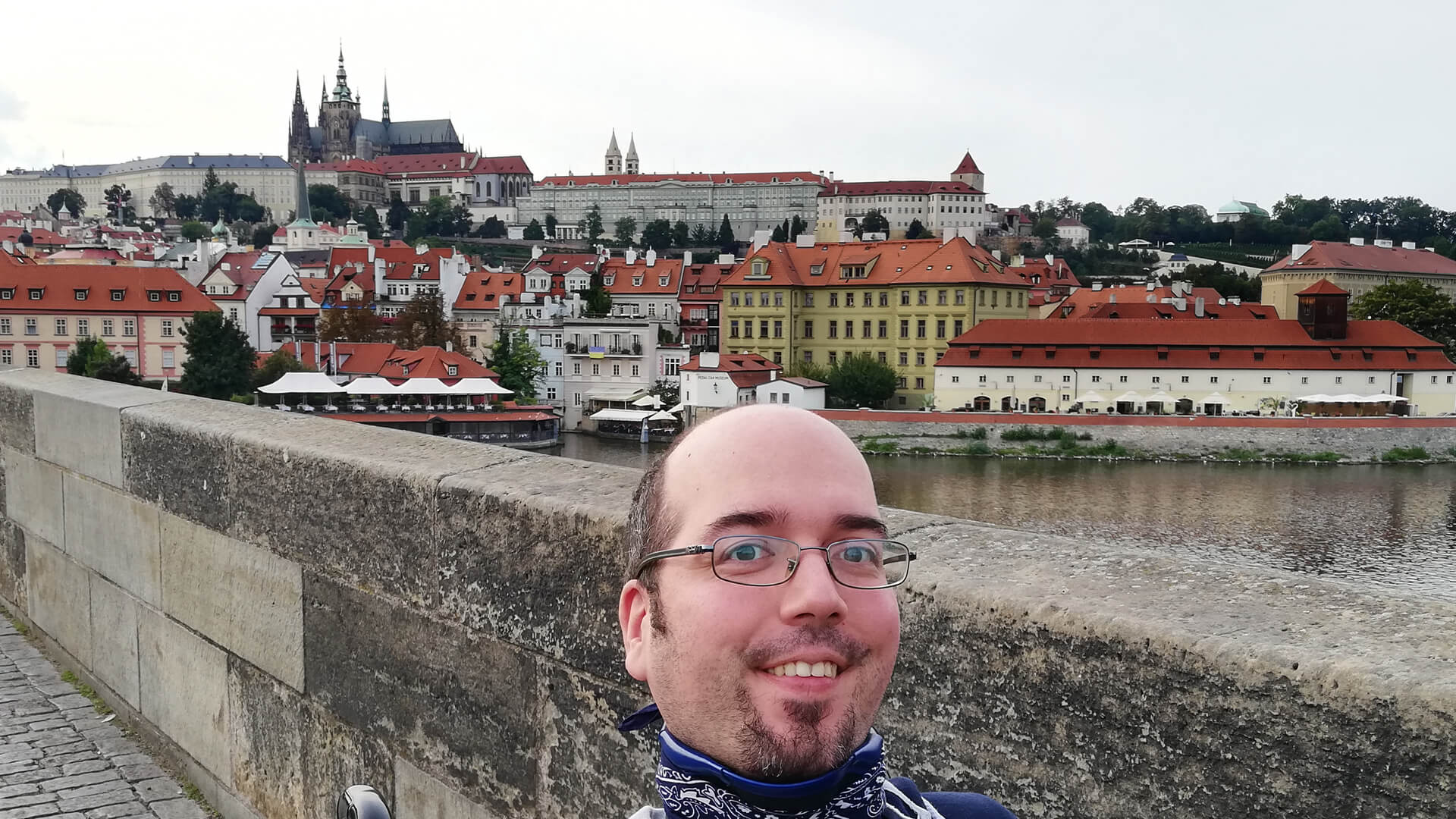
I wrote more about the Charles Bridge here. I wish I could have seen him when the king’s retinue passes this way.

The lower gate
After the bridge there is a gate with two towers.

Judith’s tower is smaller and older, it was built in the Romanesque style. The tall tower is more recent, built in the Gothic style. They offer a nice view of the bridge.

Mostečka street
Then you enter Mostička Street, which slowly leads you uphill towards the Prague Castle. This is one of the oldest streets in Prague.

Our embassy is also located here.

Church of Saint Nicholas
The Church of Saint Nicholas is a must-see on the royal route. It was built in 1704 entirely from the contributions of Count Wenceslaus Kolowrat-Liebsteinsky, whose influence in Prague society at that time was great. The church is dedicated to Saint Nicholas, who is the patron saint of children and sailors. It represents a true pearl of Baroque architecture.

Nerudova street
This street was named after its most famous resident, Jan Neruda, a famous Czech poet and writer.
Thanks to numerous fires, the houses here were constantly new and more and more beautiful. Decorated with flowers and people, they were a worthy decor for a royal procession. After this street, most tourists rush to the shortest route to the castle, but not the royal procession. They enter Uvoz Street.
Uvoz street
In this street, houses are located only on one side so as not to disturb the phenomenal view of the city. If you have decided to walk like a king, this is the place where you will stop for a while and take a look at the Petrin hill and the Prague hills.

This part of the road is very challenging for people in wheelchairs and I cannot recommend it.

After this street, the royal procession makes a sharp turn and enters Loretánská street.
Loretánská street
There are numerous important buildings such as the Church of Loreto, which has its own religious procession every year.

Here are the most beautiful buildings in Prague. The high society of Prague lived here.
Prague Castle
Prague Castle, which I wrote about in more detail here, is the goal of the coronation procession. Only the chosen can enter the castle.

This is more of a complex made up of buildings from different eras with an exciting history.

The most important among them is certainly the masterpiece of the Gothic style, which is the Cathedral of St. Vitus.
Cathedral of St. Vitus
This grandiose building, which dominates the panorama of Prague, is undoubtedly the right place to hold the coronation.

The heir to the throne enters the cathedral as an ordinary nobleman, and leaves as a king.
Wenceslas Chapel
The coronation took place in this lavishly decorated chapel.
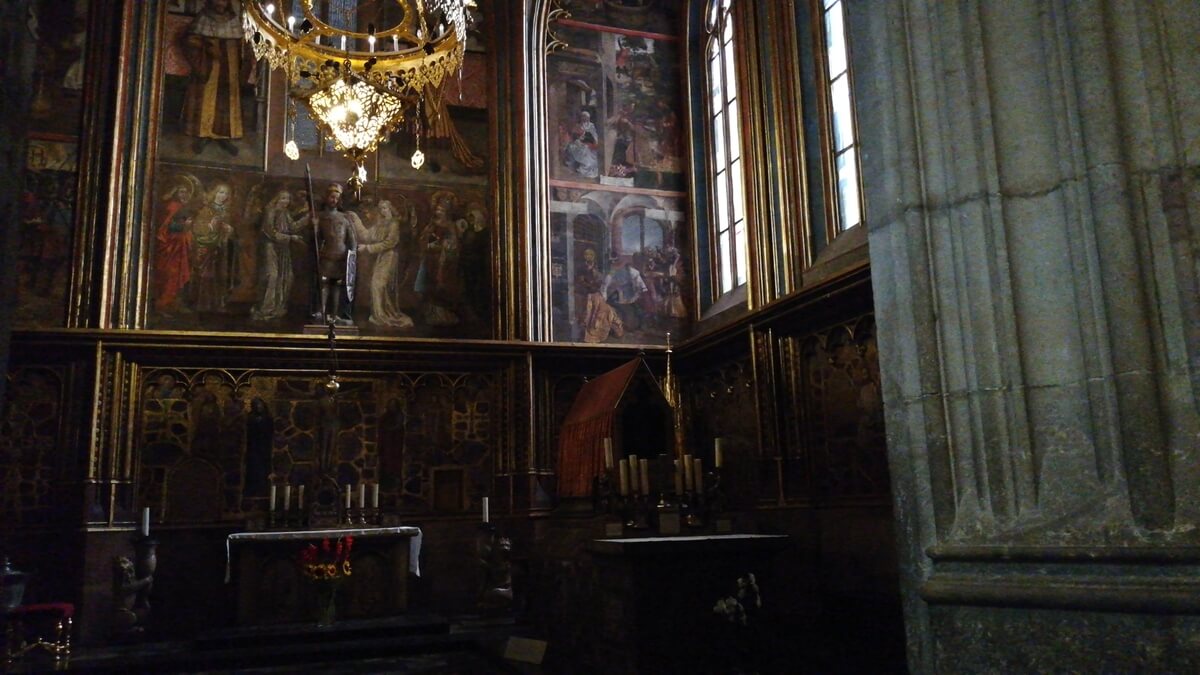
The priests bring the crown and the scepter, and the coronation ceremony is performed. The new king is anointed with holy oil and leaves the chapel with cheerful greetings. Next to the chapel are placed the most important dignitaries, who, together with the newly crowned king, approach the altar to hear the oaths. One oath is dedicated to the Czech people, and the other to the clergy. All this is accompanied by music, shouts and cannons. Then the king goes out to the courtyard to greet the other subjects, the official ceremony is over and it’s time to start the feast.
Old Palace
After the wedding, the reception was held in the Old Royal Palace, the most important part of which is the grandiose Vladislav Hall.

Here the dignitaries were greeted, with the most extravagant food, music and dancing in the best clothes.
Conclusion
This concludes the most important walk in Prague, with which you covered all the most important attractions in the city. This route is not the best solution for people in wheelchairs, for whom I recommend to end the walk at the bridge, and to visit Prague Castle in another way.

Have you traveled this route?
Did I miss something?
Traveled and enjoyed,
Marko Velickovic