Charles Bridge is one of the most important attractions in Prague. This is the oldest bridge over the Vltava River. It belongs to the list of most beautiful bridges in the world…

In order to visit it the right way, here is a short guide:
Charles Bridge is 516 m long and 10 m wide. This stone bridge connects the two banks of the Vltava River with 16 arches. This is the most important bridge in Prague, which you must not miss when you are in the city.
The bridge has been turned into a pedestrian zone full of tourists as well as locals, which does not make my walk on it any easier. Apart from crowds, cobblestones, which I feel in every part of my body when I drive over them, are the great enemy of us wheelers.

The beginning of the walk across the bridge begins with the monument to Charles IV, which was named after him.


There is also a fence with padlocks and a view of Prague Castle here.


Charles Bridge begins with this famous tower in the Gothic style.

Once the towers were used to defend the bridge, and today you can climb to the roof and admire the spectacular view of the city from a bird’s eye view.
This impressive old tower, almost black from age, was built in 1380. It greets tourists on their way to the other side.

It is decorated with various religious figures carrying shields. The old tower is more popular than the tower on the other side, but it is also more crowded, so if you don’t have time for both, choose carefully.

There are 138 steps to the top, but you’ll get there.
There are plenty of reasons to stop at every corner that make the walk over the bridge bearable.
Like everywhere else in the world before the Charles Bridge there was an unsightly wooden bridge in the early 10th century, which was subject to flooding and was replaced in the 12th century by the Judith Bridge built from stone. This was the only stone bridge in the entire kingdom, but it didn’t last more than two centuries either. In 1342, it was swept away by a catastrophic flood and the city desperately needed a new, sturdier and stronger bridge.
That is why, under the rule of Charles IV, in 1357, the construction of a new bridge began, which has withstood the centuries.

According to legend, Charles IV was interested in numerology and believed that a good constellation of numbers in the date of construction would give the bridge extra strength to withstand various challenges. That is why, according to the calculation of the astronomers of that time, the next date was chosen exactly at 5h 31m, July 9. An exact date creates a palindrome, i.e. a numerical sequence, which can be read in the same way from one and the other side of the string – 1 – 3 – 5 -7 – 9 -7 – 5 – 3 -1.
For a long time the bridge was known as the Stone Bridge and only since 1870 has it been named Charles Bridge in honor of one of the greatest rulers of the Bohemian Kingdom.

The bridge was built of limestone, but the builders allegedly wanted to add eggs to make it as strong as possible.

Since there were not so many eggs in the city, a nationwide collection was organized. Because people were afraid that the eggs would break during transport, sometimes the eggs were sent boiled to the general surprise of the builders.

Although this legend has been refuted, scientists have found some other ingredients in the building mixture, such as milk and wine. The bridge was completed only in 1402, almost 50 years later.
There are more legends related to the bridge.

Since the bridge was the only one and very important for showing the population, the authorities of the time used it as a kind of notice board.
So, for example, the heads of convicts whose executions took place in the main square would be impaled and displayed on the bridge as a warning to everyone by the authorities.
Thus, the bridge was used again after the rebellion of the Czech people against the rule of the Habsburgs in 1612. Then 27 prominent people of that time were executed and their heads were placed in baskets hung by the bridge. Apparently they hung there for almost a decade.
Because of such “cheerful” things, they say that the Prague Bridge is full of ghosts and should not be crossed at night, even though it is the most beautiful then because there are no tourists or passers-by.
But everything is so black on the Prague Bridge. Hollywood adores him so he was used many times in various films.
Until 1841, this bridge was the only one connecting the two banks, which also makes it the oldest bridge in Prague.

An interesting fact – the construction of the bridge was so expensive that you needed to pay the bridge toll until 1816.
In the 19th century, the first horse-drawn trams appeared on the bridge. Then they switched to electric ones, and then the architects discovered that the trams were too heavy and damaged the bridge, so they were replaced by buses.
Finally, only in 1965, traffic over the bridge was prohibited and the bridge was turned into a pedestrian zone.
Statues on the bridge
You have to stop on this bridge many times because the Charles Bridge is decorated with as many as 30 baroque statues, which represent the guardians of the bridge and Prague.

These statues are copies. The originals, which are from the 16th and 17th centuries, were moved to the Czech National Museum in 1965 to be preserved from time and traffic. They were replaced by replicas, some of which have already acquired the patina of a bygone era.

All the statues are dedicated to saints and patrons from past times, and the most famous statue is dedicated to Jan Nepomuk, who was the confessor of the then Queen of Bohemia.
When the king asked him to trample on the holy secret of confession, and reveal the queen’s secrets, Nepomuk refused. Enraged, the King ordered that he be thrown from the bridge, whereupon he drowned.

Then the trouble started because the bridge kept falling into the water. The bridge was thought to be haunted because of the king’s misdeeds. The king did not know what to do. The bridge was of vital importance for the inhabitants of the city. One day a determand stonecutter appeared, who said he could solve the problem.
However, he did not succeed in this and began to fear the king’s punishment. One day, a devil appeared to him in a dream and offered him help if he agreed to sacrifice the first person to cross the bridge. The stonecutter timidly agreed to make a deal with the devil.

The bridge was finished and the stonecutter, wanting no one to get hurt, went to the market to buy an animal in the hope that it would satisfy the devil. However, the devil saw through him and decided to punish him for not sticking to the agreement. Disguised as an old woman, he went to the stonecutter’s wife and told her that her husband was injured on the bridge. The frightened woman ran and crossed the bridge. The woman died in childbirth, and the stonecutter threw himself off the bridge. The bridge never collapsed again. In the end, the deal with the devil was fulfilled.
The statue dedicated to Jan Nepomuk contains five stars, which supposedly appeared in the water after he drowned. And there is the tourist mantra that if you rub the plaque on the right side, either your wishes will come true or you will return to Prague.

The view from both sides of the bridge is impressive.
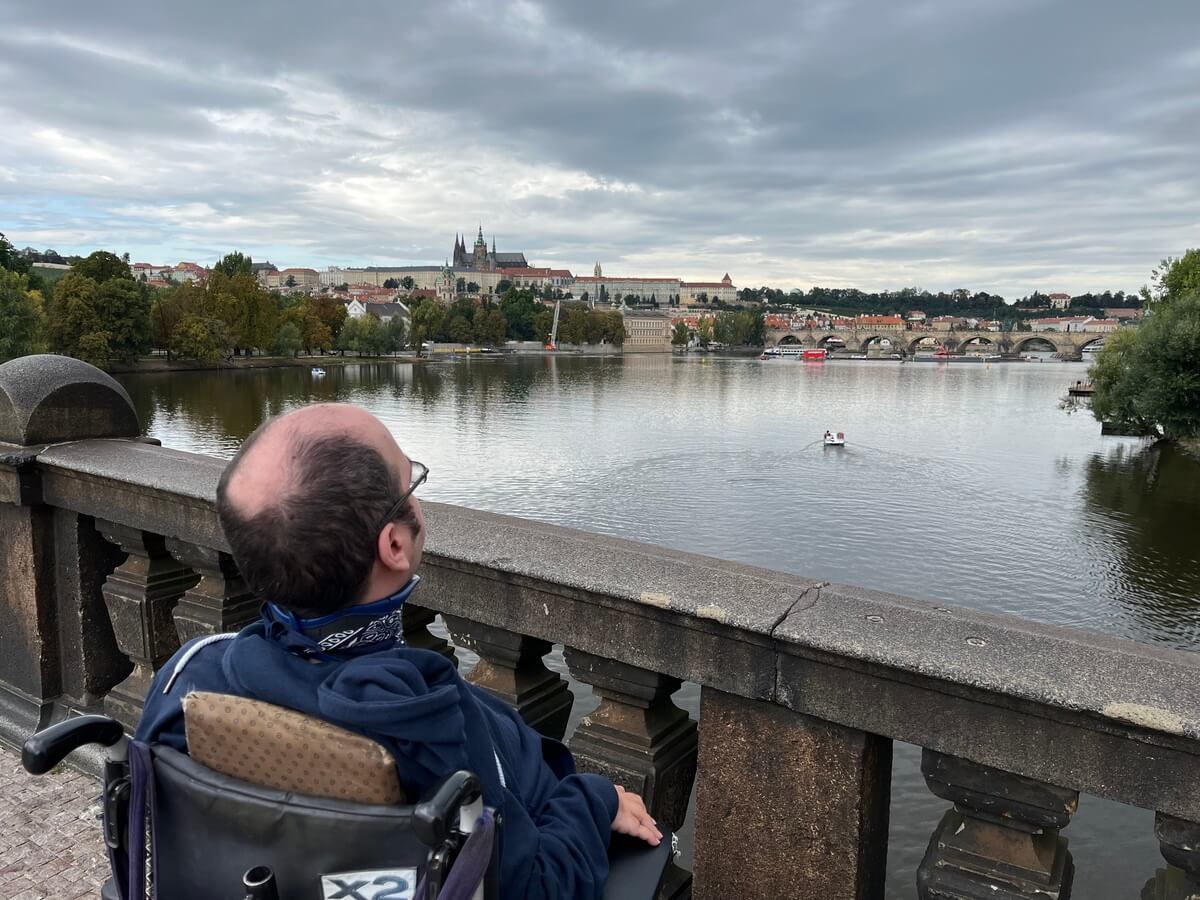
Boats full of tourists sail along the Vltava River. On one side, the first bridge you see is the Legion bridge dedicated to the Czechs. They refused to fight for Imperial Vienna in the Great War.

On the other side you can see the Manes Bridge, after the famous Czech painter Josef Manes, who created it in the 19th century.

When you reach this tower, the walk on the bridge ends.
The tower on the other side of the town consists of two, which are connected by a bridge.

The smaller tower is the only thing left of the former Judith Bridge, while the second tower was built only in 1464.

From here begins the street, which leads up the hill to the Prague Castle.

People in wheelchairs cannot overcome these challenges due to the cobblestones and the ascent, so I suggest that they visit the Prague Castle, which I wrote about here, using the tram. This was also my first ride on the tram, which is partially wheelchair accessible. You must wait for the appropriate one.

Conclusion
Although Prague today has at least 17 bridges over the Vltava. You must cross the Charles Bridge at least once when visiting the city. Although I was looking forward to seeing this bridge, I was not overjoyed by the cobblestones that awaited me there.
In any case, no matter how hard it is, the view of Prague Castle and the Vltava River make the crossing bearable for us in the wheelchairs.
Secrets and legends add to the mystique of this bridge and make this the most important walk in Prague.
And the beer that follows helps this impression.

Have you visited the Charles Bridge?
Did I miss something?
Traveled and enjoyed,
Marko Velickovic